The Klercks in the emancipation era
 The Cape’s first wine farm, Groot Constantia, built and sustained by enslaved people for over 150 years.
Photo Lesley Lawson, 2026.
My fourth great-grandparents, Willem Jan and Aletta Klerck, kept a large and luxurious house in a des-res neighbourhood of the Cape settlement. Included in their possessions were 40 enslaved people. But between the ending of the Atlantic slave trade in 1807 and the abolition of slavery in 1834 a series of laws gave enslaved people new rights, and those in the Klerck home were determined to use them. By 1829 Klerck was complaining that the good order in his home had been destroyed “so that from well-behaved persons, which they formerly were, they are now become riotous and disorderly.”
Changing times
Passed in 1823, the Amelioration Proclamation Act favoured Christian slaves, who gained the right to marry (if their owners approved), to own property, and most importantly to not have their children sold or taken away, among others. An Office of the Guardian of Slaves was also established to listen to complaints from the slaves and follow through with prosecution of excessive abuse.
Whether Willem Jan and his second wife Catharina (née Munnik) obeyed the new rules we will never know. But thanks to an inspirational contemporary Cape journalist Jackie Loos, it is clear that the master-slave relationship in Boomstraat had changed forever. In the course of her weekly articles on the experience of enslaved people (Cape Argus, 2009), Loos described a series of cases in the Western Cape Archives between Klerck and enslaved people.
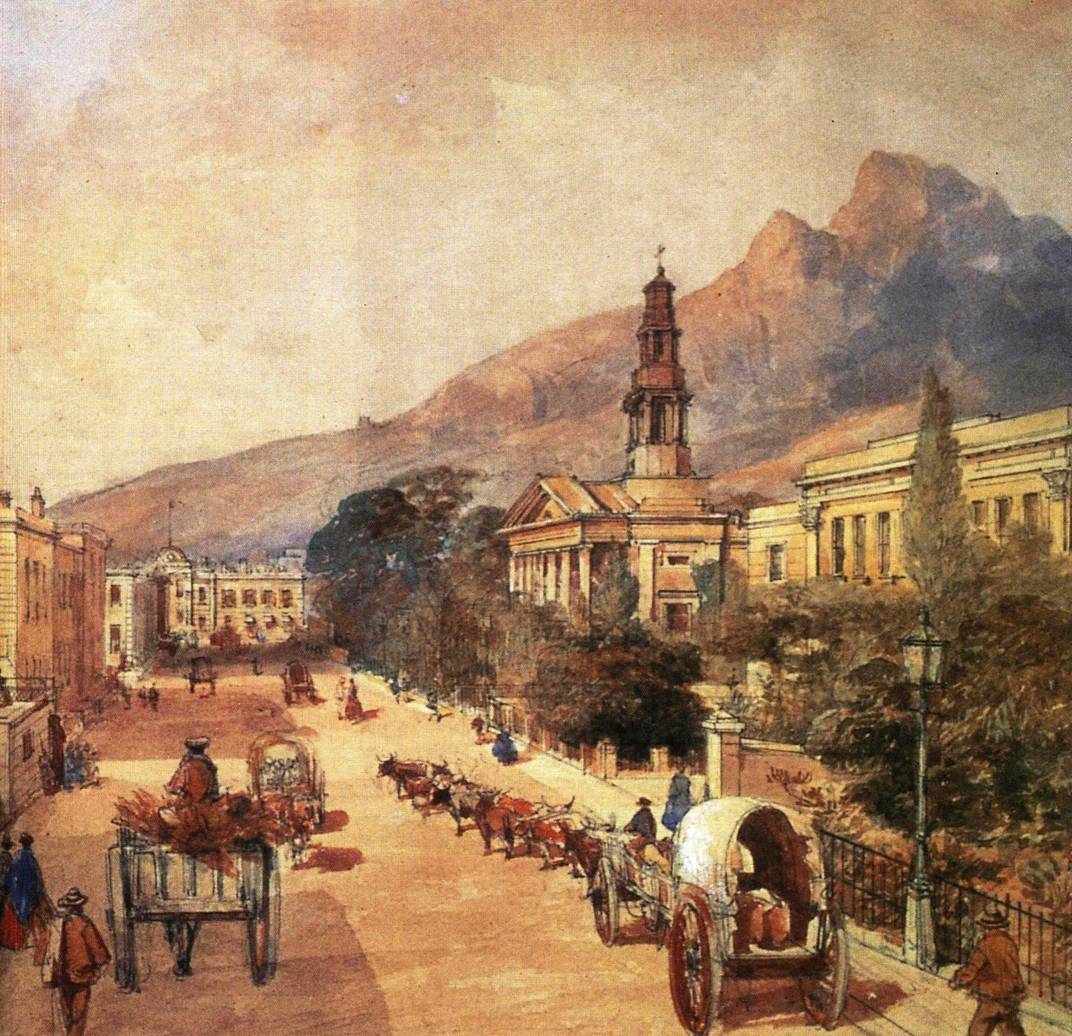 Cape Town city centre in the 1800s. Wikimedia Commons.
Dissent
In 1825 the Klerck’s coachman, Ontong van de Caab (50 years), made an official claim of freedom on the grounds that his mother, Cambang, was a free person when she came to the colony. Klerck denied this saying that Cambang had been purchased from the captain of a VOC vessel by Aletta’s aunt, and left to Aletta in her will. Although no evidence was found to support Ontong’s claim he renewed his application to the Guardian of Slaves, Major Rogers, who reconsidered the case, but denied it.
Despite the outcome, this case inspired the children of Klerck’s housemaid, Isabella of Malabar, to make a series of similar claims, which were also rejected.
Four years later, Ontong’s case was taken up by his younger brother, the tailor Jeptha. Klerck immediately gathered affidavits to assert that Cambang had been purchased, and forwarded these to the governor with the request for “the restoration of peace and good order in his family, which has thus wantonly been disturbed”.
Major Rogers accepted Klerck’s affidavits, writing to Jeptha,” If I saw you had any ground upon which to claim your freedom, I would most willingly assist you, but your case is precisely that of your brother Ontong and all his pretension rested on was the assertion that Cambang was a free person. The subject has been under repeated discussion and investigation and has always terminated unfavourably for Cambang.
“There seems to be a desire on the part of some persons to keep Mr Klerck’s slaves in a state of continual irritation against their master,” he continued, “and no sooner has the case of one been concluded than another is attempted to be brought forward… thus Mr Klerck’s slaves are in the most disobedient state, refusing to obey his lawful commands.”
Rogers advised Jeptha and all his kindred to behave themselves obediently in their master’s service “or they must expect to be punished accordingly to their deserts, which … the Guardian will have no power to prevent.”
According to Loos, Ontong was sold in 1830 and Jeptha died a slave in 1833.
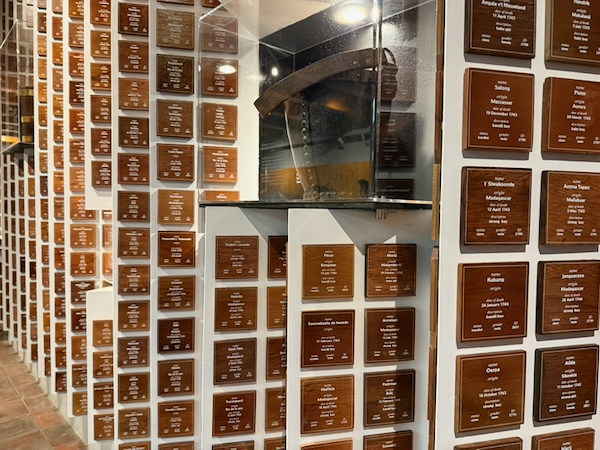 Installation at the Slave Lodge documenting every occupant who died there. Photo Lesley Lawson, March 2026.
Freedom?
Slavery was officially abolished on December 1, 1834, after which slaves were bound to a four-year apprenticeship. As “apprentices”, they had to work for free for their former masters, which meant that emancipation was not immediate. It was only on December 1, 1838, that the some 38,000 enslaved people in the Cape were freed. But for many, this was not the end of hardship. Though urban people with craft skills were able to transition to wage labour, in rural areas it was more difficult for workers to sell their labour. In this context it was not uncommon for people to stay with their former owners.
While freed slaves received no financial help to start new lives, the British government paid compensation to former slave owners for the loss of their “property”. Compensation to the value of £1.2 million was allotted to the Cape colony (roughly £173 million or R3,791million today).
University Colleges London (UCL) has established a centre for the study of the legacy of slavery that includes a database of compensation claims across the British empire. The awardees included both slave owners and secondary claimants such as mortgage lenders (yes, slaves were treated as capital). Here I found the names of my ancestors as well as the sums that they gained from the loss of slavery.
Willem Jan Klerck and his second wife Catharina were awarded around £1,700 for 47 slaves, and Klerck an additional amount of over £2,500 as mortgage lender. As for the other branch of the family, 27 descendants of Hermanus Lambertus Bosman were awarded more than £6,000.
At the time, the slave owners complained that the formula worked out by the British resulted in a lower payout in terms of the going rate for slaves. Contemporary researchers comment that the four years free labour more than made up for any shortfall.
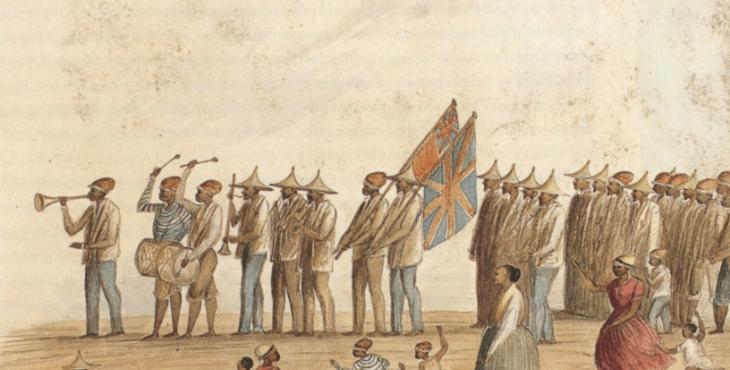 Procession celebrating the end of slavery, 1834. Wikimedia Commons.
Legacies
Contrary to colonists’ dire predictions, slave compensation was a boost to the Cape economy, enriching individuals and creating the first commercial banks. The banks were able to provide loans for farmers, resulting in a short-term increase in agricultural production and longer-term expansion of settler capitalism. The administration of slave compensation also led to the development of a new group of wealthy agents who invested their profits in trades, local real estate and urban development.
The narrative at The Slave Lodge emphasises the long-term enrichment of South African society in terms of the cultural diversity introduced by enslaved people from Southeast Asia, India and other African countries. They cite the impact on the Afrikaans language as an example: Afrikaans was spoken in mosques and there is evidence that first written Afrikaans was in Arabic script.
Many contemporary thiinkers argue that the institution of slavery helped establish patterns of socio-economic and racial inequality from which apartheid emerged. For example, three years after liberation, the Masters and Servants Ordinance of 1841 was passed. Based on the laws that governed slavery, versions of this act governed labour relations until 1974.
Key elements of slavery became embedded in the society in a way that was impossible to eradicate. The notion of people as property to be bought, sold and controlled was the ultimate dehumanisation, and the thread of this dehumanisation is woven through our history. For example regarding slaves as children and referring to them as “boy” or “girl”, no matter what their age, survived to the end of apartheid, (and beyond?).
Historian of slavery, the late Robert Shell argues that it was slavery, “not the frontier and certainly not the process of industrialisation”, that shaped South Africa.
Jan Hugo and his minder Klaas, a slave descendant, around 1905. Huguenot Memorial Museum.
Slavery and me
Slavery was not a subject that featured strongly in the struggle literature that I read avidly in the 1980s. Unlike the frontier wars, which spoke of resistance to dispossession and colonisation in the nineteenth century, slave rebellions were seldom mentioned.
In the monograph From Diaspora to Diorama, Anne Eichman suggests two key reasons for this: the regional (ie Cape-based) nature of the institution, and the notion of indigeneity. “A sense of belonging and historical rights to the land…So, slave ancestry was often replaced by claiming Khoisan descent.”
In summary, she writes, “the state, slave descendants themselves and most liberation movements—obviously each according to their own agenda and with distinct motives—were complicit in the submergence of the slave memory during colonialism and apartheid.”
It was only in 1995 when I started researching the film series God Bless Africa, that I really began to get to grips with the full extent and horror of slavery in the Cape. It was more than a decade later that I discovered my ancestors’ complicity and was obliged to add an additional bundle to my secret stash of white guilt. It reinforced the accusations of Black Consciousness challengers in the 1970s that, as a white South African, I was descended from a long line of tyrants and tormenters.
Reading some of my ancestor’s wills, I saw that property was listed room by room, with the slaves as a separate category at the bottom of the list. I was freshly outraged and bemused: that human beings could be seen as goods, like curtains, pots and pans or livestock. For example, Aletta Klerck’s grandmother, Maria Meyer lists her 41 slaves under the heading Leijfeijgenen (serfs) and indicates how they will be shared among her three heirs. They included four men who could not be sold but had a choice of which heir they wish to live with, and two female slaves with seven children between them.
Later when a close friend of mine uncovered generations of enslaved people in her ancestry, it became even more personal. Did my ancestors buy and sell her ancestors? Do I have a moral duty to make reparation? It seems an unpayable debt.
Farmer's son Jan Hugo and his minder Klaas, a slave descendant, circa 1850.
Huguenot Memorial Museum, March 2026.
References
Eichmnn, A. Representing slavery in South Africa. In “From diaspora to diorama.
The slave lodge in Cape Town, 1658-1828. Part of the UNESCO slave route projectCompiled by Robert Shell.
Ekama K, Emancipation and the Business of Compensation in the
Cape Colony. Enterprise & Society (2026), 27: 1, 88–111
doi:10.1017/eso.2025.10077
Ekama K and Ross R The Emancipation of the Enslaved in the
Cape Colony: Historiography and Introduction. Journal of Southern African Studies, 2021Vol. 47, No. 3, 405–416, https://doi.org/10.1080/03057070.2021.1907114
Loos J. Slave family’s battle to obtain their freedom thwarted by colonial rule of the day. Cape Argus, July 9, 2009
Shell, R. Children of Bondage. Wesleyan University Press, 1994
Worden, N (ed) Breaking the chains. Witwatersrand University Press, 1994
Websites:
The Slave Lodge. https://www.iziko.org.za › museums › slave-lodge
Groot Constantia: https://grootconstantia.co.za/groot-constantia-rich-history/