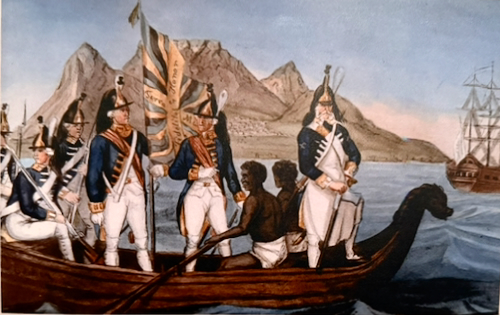
 VOC army officers being rowed ashore by slaves. Table Bay, 1783. Slave Lodge.
The ancestors whose portraits graced my childhood home represent the only branch of my family who came from patrician stock. Their bearing spoke of confidence in high office and they occupied a place of pride in our humble suburban home. Willem Jan Klerck and Aletta Wilhelmina Deneys arrived in the Cape colony in 1792 and were married a year later. For many years I assumed they were the first immigrants on my great-grandmother Suzanne Margaretha Klerck’s line, but this was soon corrected when I began to explore the “invisible” female ancestors.
 Watercolour portrait of Aletta Deneys. Family heirloom.
Aletta and Willem come to the Cape
Although Aletta Wilhelmina Deneys (De Nijs, Denys) was born in 1774 in India, her grandparents were from distinguished Cape families. Grandfather Adriaan De Nijs (1711-1761), was a VOC manager at Simonstown and Grandmother Maria Mijer (Meyer) (1714-1773), the daughter of one of the first Huguenots to settle in the Cape. They had both accumulated considerable wealth.
The little we know of Aletta’s background throws light on the global empire of the Dutch East India Company (VOC). Her father, Jacob Peter Deneys, born in Paarl, took up a commission with the VOC that eventually saw him promoted to the rank of commander of the Company’s possession of Sadraspatnam, on the Coromandel coast, east India. It was here that he married a VOC daughter, Hester Clasina Topina, and from this union, Aletta was born.
In 1781 Aletta’s father Jacob was captured by the British during the fourth Anglo-Dutch war. He was freed ten years later and returned to the Cape on the Danish ship Thetis. Accompanying him was his nineteen-year-old daughter Aletta who was to see South Africa for the first time.
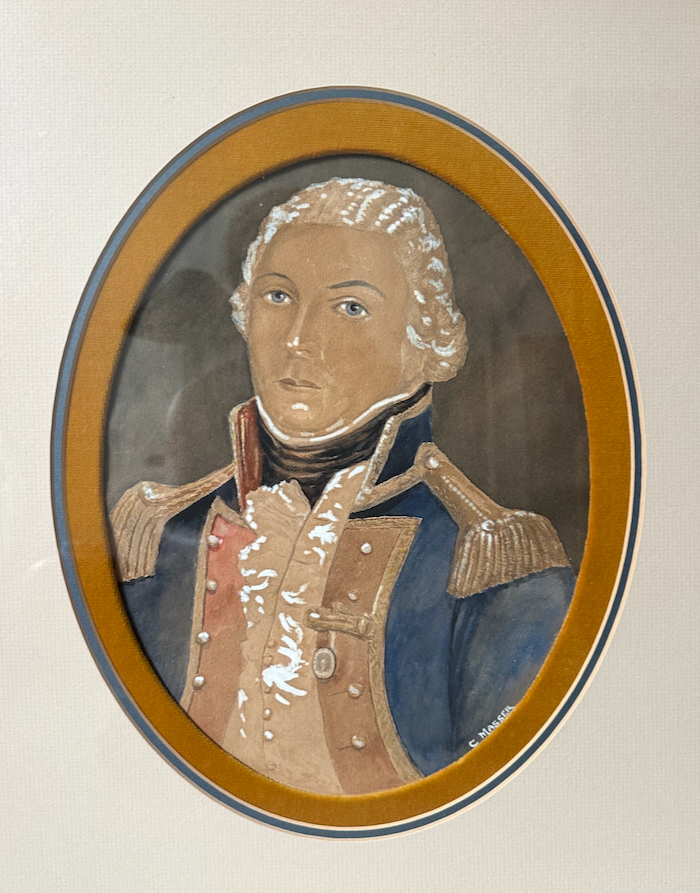 Portrait of Willem Jan Klerk. Family heirloom.
Willem Jan Klerck was from an aristocratic Dutch family that served in the Renen town council for many generations. He served in the Dutch navy and in 1791 became Captain and commander of the naval frigate De Swaluw which took him to the Dutch East Indies. It is likely that on one of these journeys he met Aletta. In any case on his return to Europe, he requested six months leave as he was engaged to be married. This being granted, he sailed to the Cape, probably on the Thetis with his fiancé and father-in-law. o be. William and Aletta were married in the Cape in1793.
Life in Boomstraat
Willem was employed as a senior civil servant in the VOC with control over legal and financial matters in the colony and remained in office after the British occupation of 1804. He built a handsome house for his wife and four children in Boomstraat (now Commercial Street). This was a desirable part of town where high-ranking civil servants of the VOC sat on their stoeps of an evening smoking their long Gouda clay pipes.
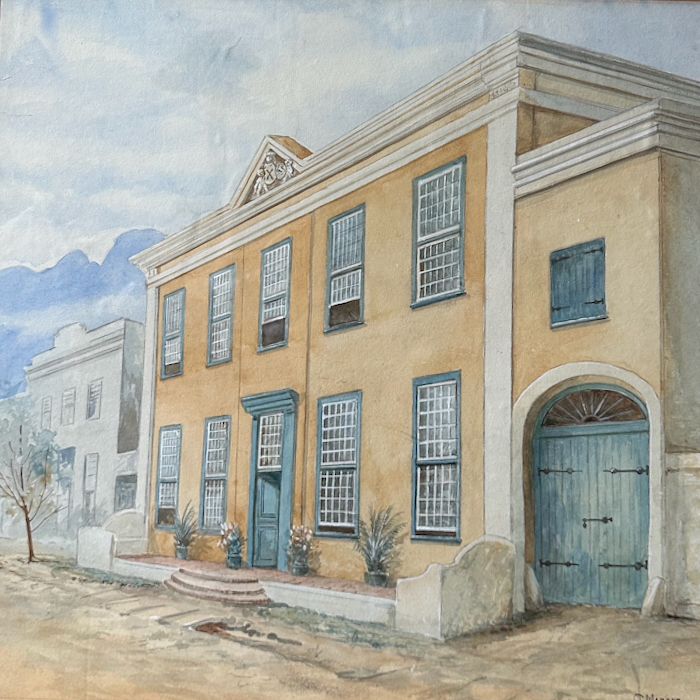 Water colour painting of the house in Boomstraat. Family heirloom.
The couple had five children before Aletta died the day before Christmas in 1816. Though Willem Jan may have been heartbroken to lose his beloved wife, he remarried three months later.
 Indian chintz dress made on the Coromandel coast said to belong to Aletta.
Seen in SA Cultural History Museum.
From culture to slavery
In March 2026 I went in search of the oil miniatures of my ancestors that I had seen a decade or so earlier in the SA Cultural History Museum (see Ancestor portraits). But I discovered that that institution was no more, and alas my ancestors’ portraits, the painting of their house and Aletta’s wedding dress were no longer to be found. In its place stood a new museum more appropriate for post-apartheid South Africa: The Slave Lodge. It displays a wealth of material on the history of slavery in the Cape—a topic not irrelevant to Mr and Mrs Klerck, as we shall see in my next article.
The building that housed the erstwhile Cultural History Museum has been through many identities that reflect the changing times of the country. It was indeed built in 1679 to house VOC slaves. In 1811 the British authorities repurposed the building as government offices. It was later used as South Africa’s first library, then first post office, and between 1815 and 1914 it housed the Cape Supreme Court. In 1960 the apartheid government restored the building and opened the SA Cultural History Museum dedicated to objects and art works associated with white culture.

In the early post-apartheid period (1998 ) the building was renamed The Slave Lodge. This re-ncarnation was not without its challenges, as Anne Eichman describes in the monograph From Diaspora to Diorama. Despite the official name change, it was not until 2005 that a permanent exhibition on slavery was installed, after many institutional and financial obstacles were overcome.
Eichman writes: “In summary, discussions around the script complicated the process and contributed to the delay of the opening of the exhibition. I would argue that historical inaccuracies, factual errors and the inadequate language level were perceived of as the major problems.
“However, there was also disagreement around the basic approach of how to present slavery in the text, i.e. in an emotional and decidedly subjective way that highlighted the inhumanity and brutality of the system, or as a more 'positive' story that included achievements and negotiating powers of slaves granting them subject status in history. The result of this controversy is a text that clearly evades a story of victimization and tries to convey a more balanced and complex picture of slavery. Rather than sending out a strong emotional message, it tends to assume a more detached position and to provide information and facts in a neutral narrative–leaving it to objects and other audio-visual components of the exhibition to engage the visitor emotionally.”
References
Michael von Petersom Klerck: The Klerck family history, various documents, unpublished.
Robert Shell (ed) From diaspora to diorama. The slave lodge in Cape Town, 1658-1828.
The Slave Lodge. https://www.iziko.org.za › museums › slave-lodge