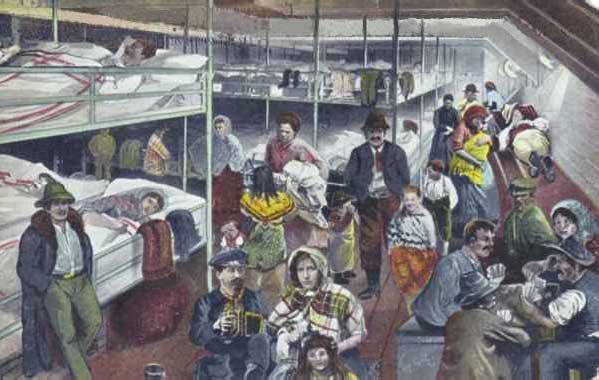
 Steerage passengers on a steamship, 1890.
The disappearance of my paternal grandfather from our childhood went without a mention, and it was only when my brother began investigating my father’s family line in 2009 that I learned more about him. A sketchy biography in the South African Jewish Yearbook of 1926 provided his birthdate and sufficient detail for further research.
I discovered that Grandad Philip Lazarus, was born in Whitechapel, London in 1875. His birth certificate describes his father Samuel as a traveller, in those days another word for pedlar or hawker. His mother Sophia (née Abrahams) signed the certificate with a cross. This scant information suggests that my illiterate (ie in the Latin alphabet) grandparents were likely part of a growing group of refugees from Eastern Europe.
Armed with this new information I went searching for the Lazarus family in the UK archives. They only appear in one national census—1871, before grandad’s birth, suggesting that they did not stay in England for long.
By 1871 Samuel and Sophia had five children. The two eldest, Flora and Lewis, were born in Russia (1859 and 1863 respectively). The third child, Moses, was born in Newport, Wales (1866); the fourth, Marian (1868) in Bristol; and the fifth, a one-year-old girl, (name indecipherable) was born in Middlesex (London).
From the dates and places of their births it is possible to guess at the many journeys of these travelling folk: emigration from Russia to Wales between 1863 and 1866, travel from Wales to west England between 1866 and 1868, and a move to London by 1870. It is likely that there were other children before and after Grandad Philip was born, but this I have not been able to establish.
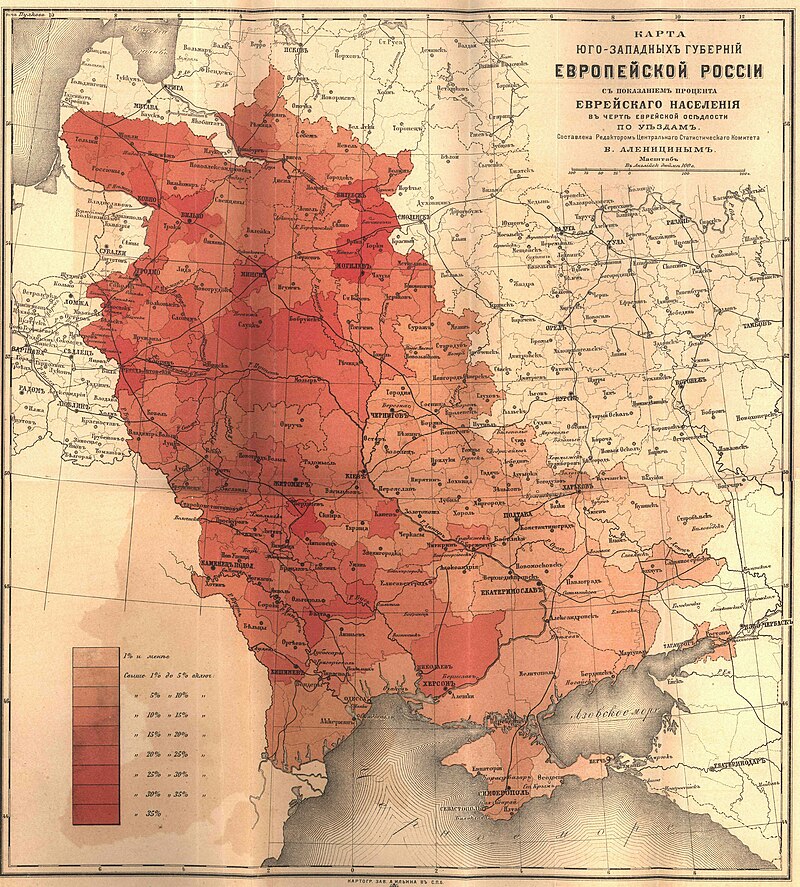 The Pale of Settlement, 1884.
Leaving Russia
The family originated in the Russian Empire, most likely the Pale of Settlement, which was the only part of western Russia where Jewish people were allowed permanent residence. Until 1861, the majority of its inhabitants were rural farmers, but new land reforms barred Jewish land ownership. It became increasingly difficult for Jewish families to survive and more than 70% became paupers. By the time the Lazarus family emigrated, a whole new sub-class of artisans and petty traders had arisen.
These conditions no doubt informed the decision of young Samuel and Sophia Lazarus (in their 20s) to try their luck in the west. But it was not possible to just pack up their two small children and go. It was an expensive business, so money had to be saved or borrowed. Getting to a seaport also involved months of preparation and travel.
For Jewish peasants migration was illegal, and like many of their countrymen, the young family had to make a dangerous journey to one of the German ports near Hamburg, or to Riga in Latvia. First, they travelled by wagon or train to a “green border” where they crossed illegally, and then to the coast. This involved a large network of people smugglers, local agents and innkeepers— people who knew the route, who to bribe, and how to book steamship passages.
This long and arduous journey was accomplished with two young children under the age of seven years. After this the Lazarus family had to cross the ocean before arriving at their destination.
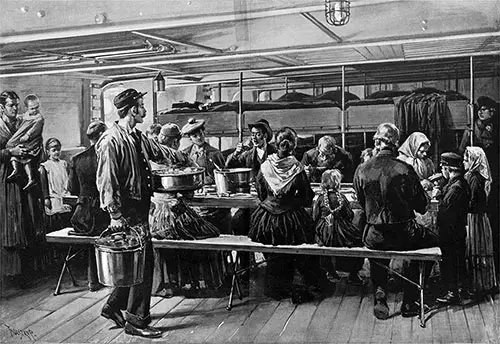
Mealtime for steerage passengers on a steamship.
Sea passage
We can assume that our Lazarus family travelled in the cheapest class, steerage. People were regarded as freight and largely confined to their sleeping quarters, which were large compartments accommodating 300 or more people. Meals, often inedible, had to be taken in the foul air of the berth; and washing facilities were rudimentary, with dozens sharing a single bucket of cold water.
Much can be learned from the report of the USA Immigration Commission, which investigated trans-Atlantic steerage travel in 1909. By now conditions had likely improved since the Lazarus journey some 50 years earlier, but even so, the report makes for grim reading.
One of the commission’s agents, Anna Herkner, boarded three different steamships from the German ports to observe conditions for herself.
“Only the fresh breeze from the sea overcame the sickening odors,” she writes. “The vile language of the men, the screams of the women defending themselves, the crying of children, wretched because of their surroundings, and practically every sound that reached the ear, irritated beyond endurance. There was no sight before which the eye did not prefer to close. Everything was dirty, sticky, and disagreeable to the touch… For fifteen hours each day I witnessed all around me this improper, indecent, and forced mingling of men and women who were total strangers and often did not understand one word of the same language.”
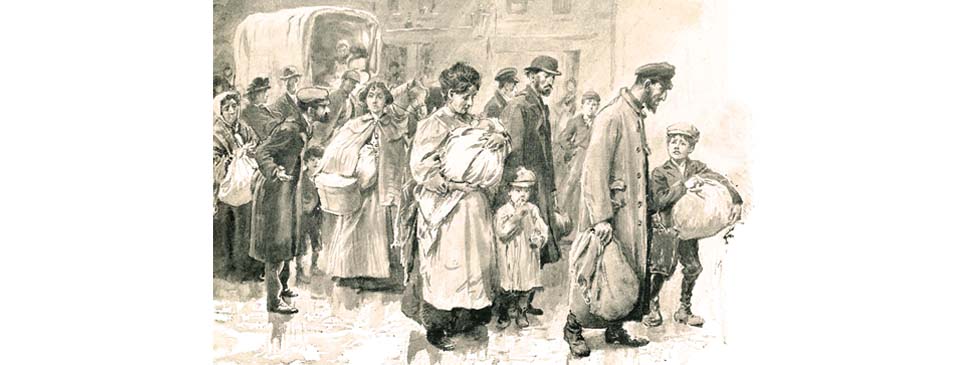 New arrivals.
Arrival
The majority of Russian Jewish émigrés of their time were bound for the USA, and most of those that disembarked in England did so at eastern ports of Hull and Grimsby. So why and how did Samuel and Sophia land in Newport, Wales?
It seems likely that they were among those who were cheated by unscrupulous agents who sold unworldly travellers tickets for the UK, instead of to the USA (Newport, Rhode Island being a common desired destination). When they landed many did not even know where they were and were vulnerable to abuse at every turn. It was common for Yiddish-speaking thieves to meet new arrivals at the dock and promise them help and lodgings before leading them down dark alleys and robbing them of everything that they had.
The writer George R. Sims witnessed a group of Jewish arrivals at this time being ferried ashore in London. He wrote that the boatman demanded six pence from each traveller before he would release their luggage. “Two English policemen, stolid and self-possessed, listen to the complaints poured into their ears in half a dozen languages and say nothing,” he writes. “When I explain to one that a gesticulating Pole wants to give the boatman into custody for refusing to give up his bundle without the sixpence is paid, the policeman grins and says ‘Lor now, does he?’. With their faces woe-begone, their heads bent, [the arrivals] appear more like a gang of convicts marching to the mines than free men and women making their acquaintance with the capital of the British Empire.”
Whatever the specifics of their circumstances, the Lazarus family would have connected with the small Jewish community in south Wales. According to the Jewish Cultural Centre, male breadwinners, without skills or capital, typically started out as pedlars, “widely known in both Wales’s farming and industrial communities. They sold inexpensive jewellery, watches, textiles, household goods and the like from door to door on credit.”
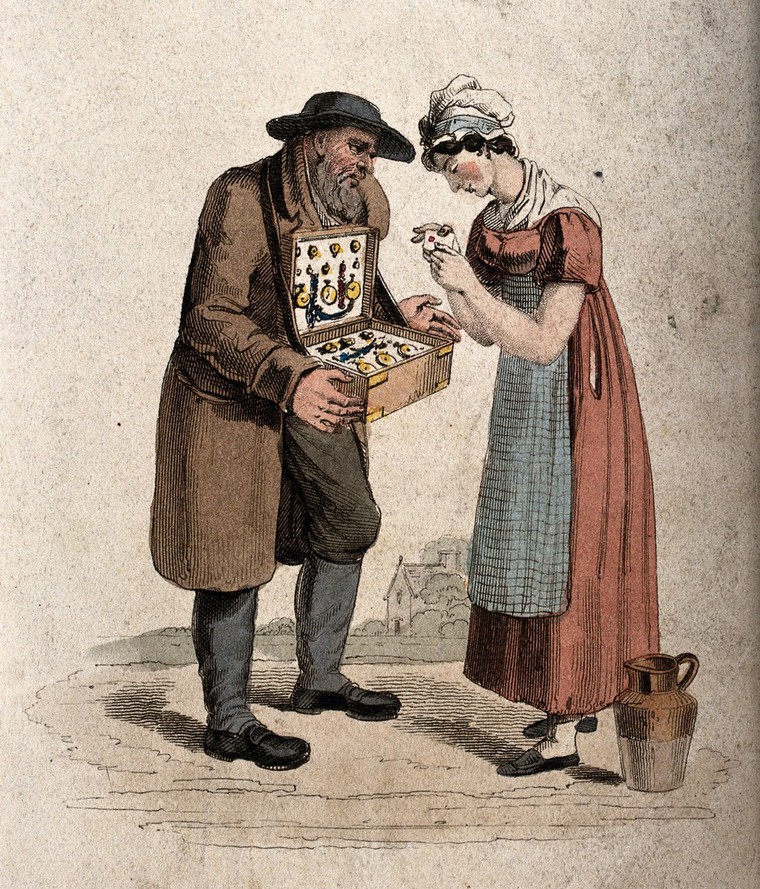 A Jewish pedlar selling watches and jewellery, 1827. Wellcome Collection.
Appalling ghetto
The Lazarus family stayed in the area for several years before moving south to London. Here, they settled in Whitechapel, which was the centre of the Jewish community in England. A commentator at the time described Whitechapel as an appalling ghetto of inhuman, poverty. “In this single parish are congregated some sixteen thousand poor Jews. Twenty thousand more are easily included within the half-mile radius. Yet strange as it may seem, this great and largely squalid colony is a peaceful and law-abiding population. Drunkenness unknown, the Jew is never intoxicated. Personal violence was unknown, licentiousness among women was rare and family ties were sacred.”
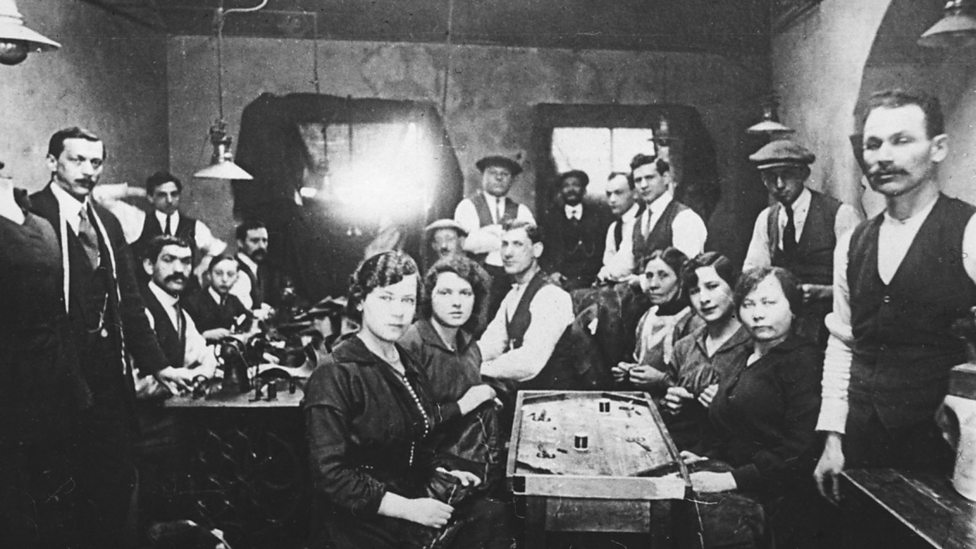 Jewish migrant workers in a Whitechapel sweatshop in the late 19th century.
The family’s stay in Whitechapel was brief. In 1877, like migratory birds looking for warmth, the Lazarus family, continued their journey southwards. Grandad Philip was two years old, the youngest of five (or more?) siblings.
Their decision to travel to South Africa was no doubt motivated by rumours of wealth and opportunity in the new world. One of Whitechapel’s most famous sons, Barney Barnato, was the son of Jewish immigrants working in the second-hand garment trade. Despite their humble origins, Barnato and his brother had managed to buy a significant share in the Kimberley diamond mines within a few years of their emigration.
I like to image Sophia Lazarus exchanging gossip with Barney’s mother at the marketplace and encouraging Samuel to take the next step.
References
South Africa Jewish Yearbook, 1929, p347.
Litvak Migratory Decisions in the 19th Century And Their Consequences: Prussian Transit Migration:https://avotaynuonline.com/2008/07/litvak-migratory-decisions-in-the-19th-century-and-their-consequences-prussian-transit-migration/
Opening gates to the west: Lithuania and Jewish migrations from the Lithuanian provinces 1867 to 1914:T homas Balkelis, University College Dublin.
The Steerage Experience: Reports of the Immigration Commission, 1909.
Jewish Newport https://thisisnotgwent.co.uk/jewish-newport/
Welsh Jewish Cultural Centre: https://www.jewishheritage.wales/post/explore-the-history-of-the-jewish-people-in-wales
London Jewish history: https://www.thehistoryoflondon.co.uk/londons-jewish-community-in-the-19th-century-part-1-their-arrival/
Hopeful travellers: Jewish migrants and settlers in nineteenth century Britain. Harold Pollins. The London Museum of Jewish life. Research Papers. Number Two. May1886