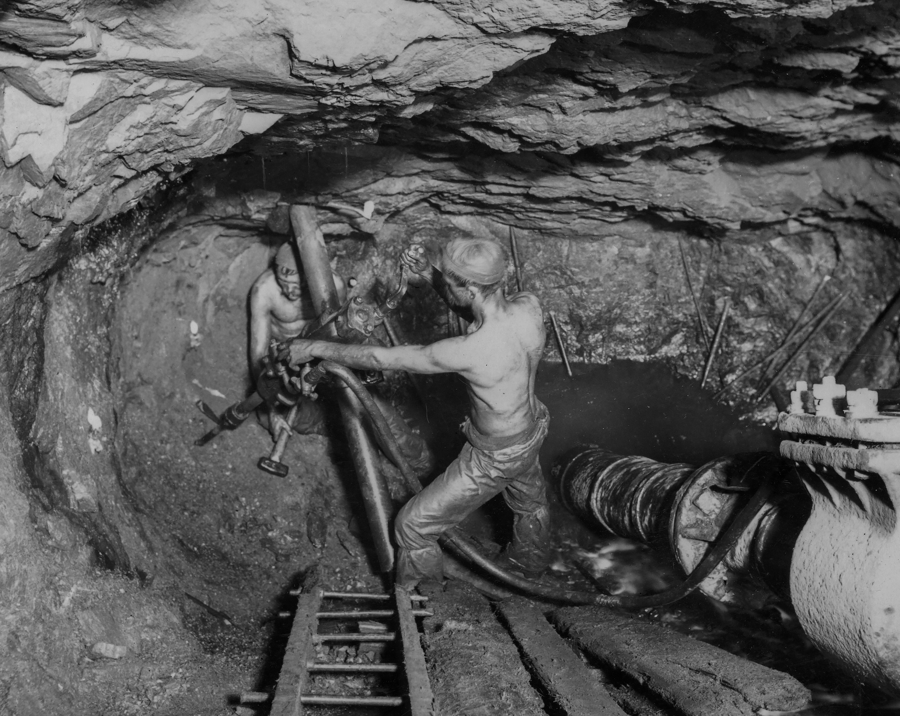
 By 1906, large numbers of Cornish miners were leaving the Witwatersrand and returning home to England with miners’ lung disease. In some Cornish villages dying men could be seen lying on their mattresses outside the houses, taking fresh air in their final days.
Already by 1904 The Cornishman newspaper reported from South Africa on “the long line of mourners following poor Cousin Jacks to their rest. It was a point of honour with the victim’s fellow workers to take part in the long procession, looking very uncomfortable in their Sunday best.”
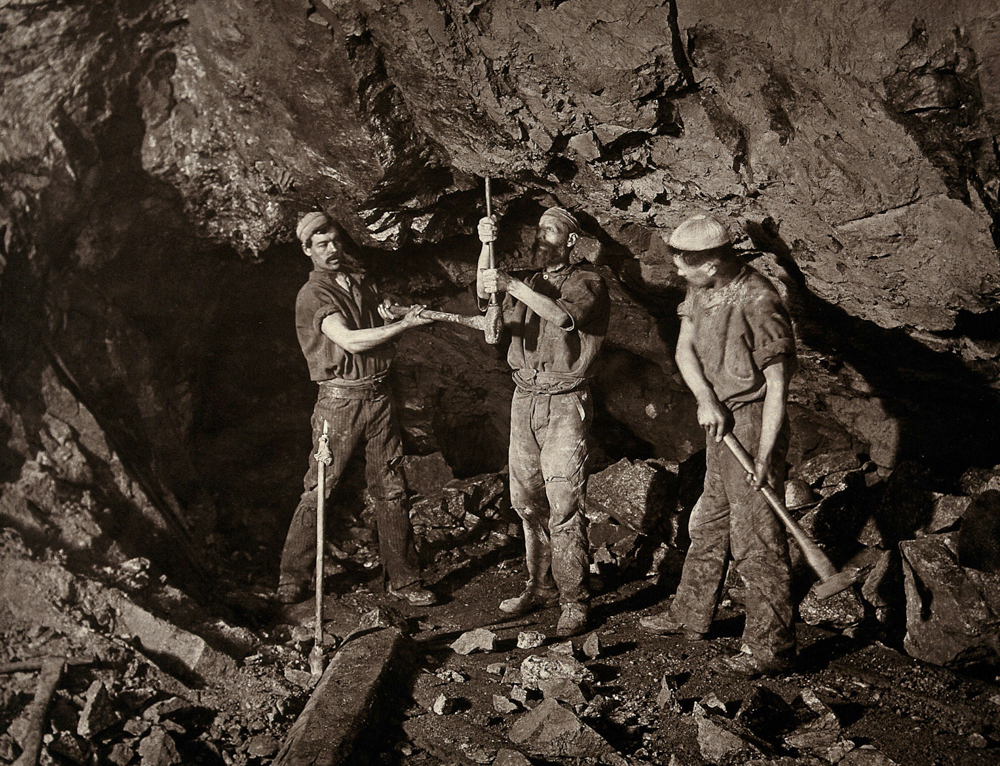
Death from lung disease was not uncommon in English mines—indeed it had already taken the lives of several of my ancestors. Named “miners’ phthisis”, the cause of the disease was not well-known. For example, a 19th century monograph attributed it to “the use of the miner’s candle for lighting purposes and the use of powder for blasting”. Later it was thought to be caused by a bacterial infection. By 1910 it was accepted that silica dust was the cause of this lethal disease, and death was often due to a toxic combination of silicosis and tuberculosis. The dust spewed out by rock drilling was the major culprit.
The conditions underground in the South African gold mines were that much worse than those in Cornwall or Lancashire. This was due the extraordinary high levels of silica in the rock.
The Transvaal Mining commission of 1910 estimated that lung disease accounted for 61% of all deaths of the Reef’s white males over the age of 20 years. In 1912 the average working life of a rock driller on the Witwatersrand gold mines was seven years and the average age at death, 33 years.
Compensation?
This scourge must have been well-known to Grandfather Samuel Pearce and Great-grandfather James Roach before they emigrated to South Africa, but they probably thought it was worth the risk. In any case James, who went underground at the age of 14 years, had already been fully exposed.
So it was that on April 5, 1915, just six years after the Pearce family arrived on the Reef, Great-grandfather James died. He was 51 years old and had been working underground for 37 years. The death certificate noted he had suffered silicosis for several years, and influenza for 14 days.
For his 46-year-old widow Eliza-Jane, this experience echoed that of her mother Jessie—also widowed by miners’ phthisis (read here) at a young age and in a new location away from her extended family. But like Lancashire’s Roose village, the Cornish mining community on the Witwatersrand supported Eliza-Jane, and she continued to live in the Malvern house with her daughter, my grandmother Mabel. By now, her eldest daughter Rose had married one William Ward, an inspector on Simmer and Jack Mine. Two years later when Mabel married Samuel Roach it is likely that Eliza-Jane moved in with them, or they with her.
Now that black miners were operating the rock drills underground, their exposure to the killer silica dust was great and they too succumbed in large numbers to miners’ phthisis. By 1910 phthisis caused nearly one fifth of all African deaths on the Rand.
The South African gold mines were the first in the world to compensate silicosis and tuberculosis as occupational diseases. However, implementation was highly racialised. Great-grandmother Eliza Jane would have received a modest lump sum and a monthly pension after James’s death. By comparison, an ailing black miner would most likely be repatriated to his rural home without a diagnosis. And die there without compensation. When compensation was paid to a black miner it was a fraction of the amount awarded to his white counterpart. (As recently as 1984 this was 10%.)
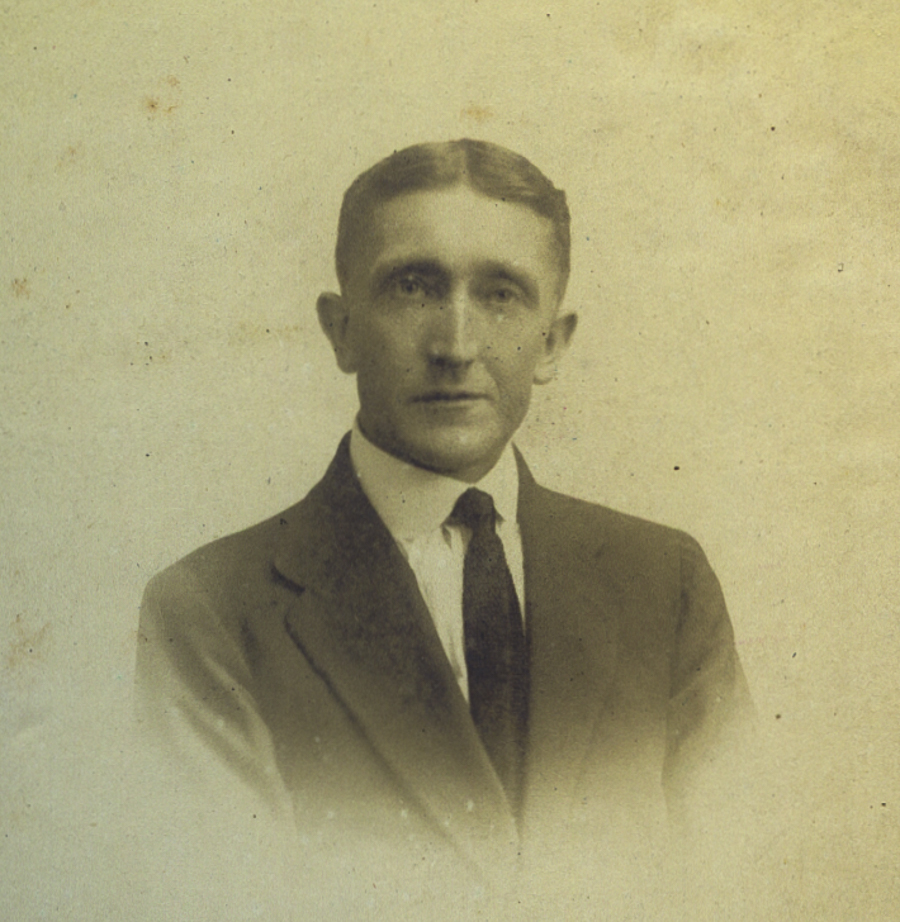 Samuel Roach, around 1916
After just 14 years of working underground, phthisis came to find Grandfather Samuel too. When he was first diagnosed, around 1923, his lungs showed signs of damage, but he was not yet ill. Not wishing to follow his father-in-law, he took his compensation and resigned from the mine.
So here endeth the story of our family’s chase across the globe for mining wealth.
Another ending
For decades the mines of the Witwatersrand were the largest gold producers in the world but by the 1970s output had begun to decline. This was due to the increasing expense of mining the ore, and the discovery of new cheaper sources of gold in other countries like China, Australia and the US.
This pattern echoes the personal experiences of my mining ancestors who chased the dwindling ore across mines in Cornwall, in Cumbria and then in the new world. I wonder when humanity will ever learn the lessons of finite resources—that simply shifting profligate extraction from one source to another cannot go on forever.
In the case of my family and the Witwatersrand gold reef, surprisingly I was the family member next in line. Not as a miner, but as a resident of a mining village abandoned when Crown Mines ceased operations in 1977. For 12 years after that Langlaagte Deep became home to a fertile community of anti-apartheid activists, cultural workers, educationists, NGOs workers and trade unionists. But therein lies another tale…
Now, in 2025, Langlaagte Deep is an informal settlement: home to refugees, the homeless and unemployed. Unlike in our day, normal services have been withdrawn and when I visited in 2013 there was no evidence of running water or electricity, and open sewers criss-crossed the village. “My house” stood without doors and windows but was gratefully inhabited by a Zimbabwean national with no papers to be in the country.
 Screenshot of Langlaagte Deep, October 2025.
The abandoned gold mines have met a similar fate. Across the Rand, artisanal miners known as zama-zama (meaning “we are trying” in isiZulu) venture underground in the hope of finding gold-bearing rock, from which they extract minute quantities of gold by hand in a process using mercury and water. This can only be a life-threatening venture. The media reports that they are often heavily armed with rifles and terrorise local communities.
The plight of the zama-zamas hit the news in January 2025 when 87 miners died in an abandoned mine shaft. This was the direct result of a decision by the authorities to “smoke them out”. Security officials cut off food, water, and other essential supplies to miners trapped underground, and delayed a rescue operation.
And as for phthisis compensation in post-apartheid South Africa: In July 2019, the South Gauteng High Court approved a class action settlement of £268 million for eligible mine workers and their dependents in Southern Africa. Six years on, many miners are still struggling to be paid before they die…
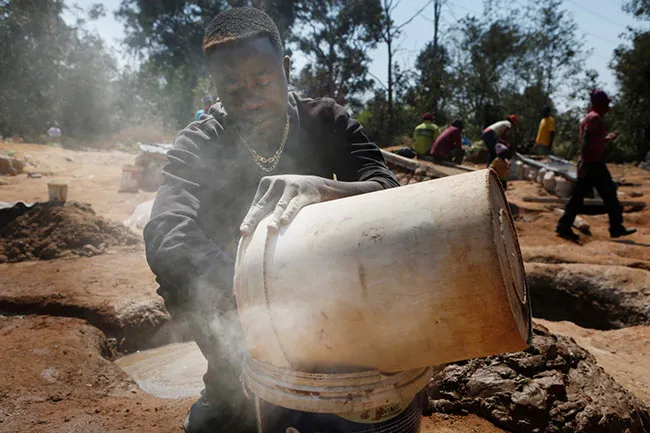 A zama-zama using a barrel containing water and mercury to extract purified gold, 2016.
Photo: courtesy of Alexia Webster.
References
ACTSA website: https://actsa.org/justice-for-south-african-gold-miners/
Burrow J et al. ‘Mongst Men and Miners, 1893. D Bradford Barton, Truro.
Burke G et al. The Profits of Death: A Comparative Study of Miners' Phthisis in Cornwall and the Transvaal, 1876-1918. Journal of Southern African Studies, November 1977
Dawe, R. Cornish pioneers.1998, Short Run Press, Exeter.
Ehrlich, R. A century of miners’ phthisis on the South African gold Mines. Any end in sight? University of Cape Town, 2007
Mabaso, M. Legacy Gold Mine Sites & Dumps in the Witwatersrand: Challenges and Required Action.2023. DOI: 10.4236/nr.2023.145005
McCulloch, J. Medicine, Politics and Disease on South Africa's Gold Mines. Journal of Southern African Studies, 2013. Vol. 39, No. 3, 543-556, http://dx.doi.org/10.1080/03057070.2013.818850
Mnisi, A. Death of miners in South Africa, a government failure. Human Rights Watch. https://www.hrw.org/news/2025/01/22/death-miners-south-africa-government-failure
Alexia Webster and Janet Munakamwe. Artisanal gold mining in South Africa, 2016, Photoblog https://blogs.lse.ac.uk/africaatlse/2016/02/15/photo-blog-artisanal-gold-mining-in-south-africa/