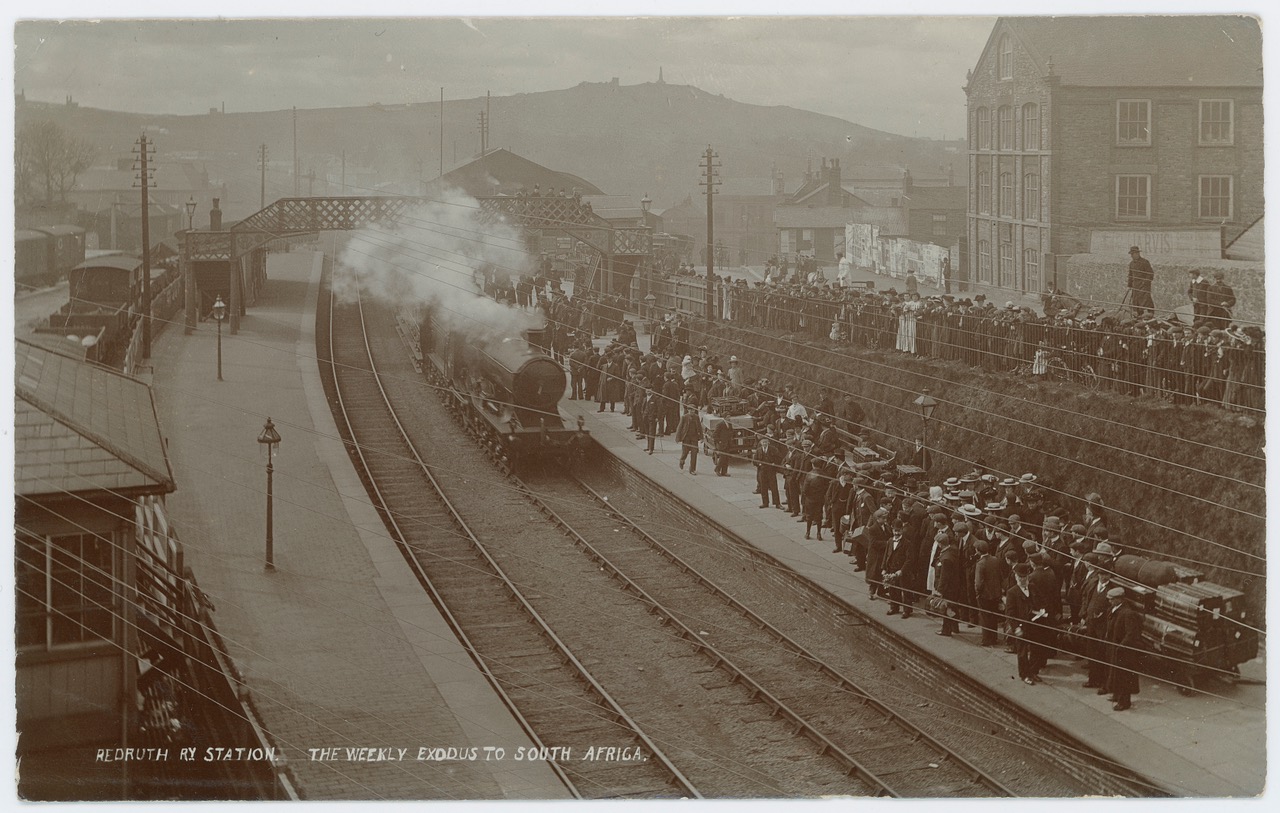
Miners departing for South Africa, Redruth station, 1905. Kresen Kernow archives.
In 1909 my grandfather, Samuel Roach, would have been one of the men on this same station platform en route to the rich gold reefs of South Africa.
An old sea captain told English writer Bernard Hollowood “of a Friday the platforms’d be packed with a great crowd of people, laughin’, cryin’, shoutin’ and so on. Then the train would steam in slowly and there'd be a great rush for the special carriages labelled “Southampton”. Then there'd be kissin’ and shakin’ and she’d move out, leaving the womenfolk and the children wavin’ and sobbin’.”
Cornish miners were renowned for their skill in hard rock mining and were actively recruited for the mines of the Witwatersrand. They were so valued that a free weekly train was laid on to take them from the railway towns of Cornwall to the port of Southampton, where they would board ship for the Cape.
How Grandfather Samuel got himself a job as a miner we will never know. As we have seen in previous posts he was from a long line of fisherfolk and mariners. But the decline of the fish catch meant that Samuel’s generation of St Ives Roaches was the first to leave the sea. At the time of the 1901 census, Grandfather Samuel had reinvented himself as a house carpenter.
Perhaps he applied for a job as a carpenter on the mines, or perhaps he was economical with the truth - confident his countrymen would show him the ropes. In any case it is likely that he was recruited in Cornwall by a relative who was a mining agent. By the age of 26 years, with few prospects at home, Samuel sought his fortune elsewhere.
The parish next door
Droves of men had already left for the Witwatersrand. In the last 40 years of the 19th century, as the Cornish mining industry declined, the county is estimated to have lost nearly half of its young male population (15-24 years). Some, like my Pearce ancestors, first moved to other pits across the country, and only when the mines there were threatened, did they make the huge decision to emigrate (see previous post). Many, like great-uncle Nathaniel went to the new world where the ore was plentiful and cheap to mine. South Africa’s Witwatersrand, however, offered the richest goldfields in the world. After they opened up in 1886, they became the prime destination for Cornish miners.
There was also a pull factor: wages for skilled miners on the Witwatersrand were the highest in the world.
Johannesburg was so well known in Cornwall that people regarded it as “the parish next door” and mines such as Simmer and Jack, Randfontein and Crown Reef were household names. Young miners came home with tales of wealth, though others returned with lung disease from the foul underground air.
 A map of Witwatersrand goldfield, South Africa, showing properties of the Rand Mines Limited. 1895.
Chromolithograph after Edward H. V. Melvill. Wellcome Collection.
By the time Grandfather Samuel and Great-grandfather James Pearce arrived on the reef, Cornish mining migration had slowed considerably. Many had returned home during the Anglo-Boer war, and conflict over skilled jobs and wages in the first decade of the 20th century had made South Africa a less attractive destination. Nevertheless, there remained a large Cornish population in Johannesburg and the other settlements surrounding the gold reef.
I often wonder what grandfather Samuel would have made of the Witwatersrand when he arrived. After a lifetime of gazing at the ocean through the soft light of St Ives, he was now faced with the harsh sun, dry veld and mining wasteland. The 19th century writer AL Rowse spoke of “that teeming antheap of the Rand, the raw horror of Jo’burg and the gaunt visaged men, yellow-faced who returned home to gasp their last breath.”
Having made a similar journey, from the coastal port of Durban to Johannesburg, I am perhaps overidentifying. I still remember the metallic taste of the air when I stepped out of the car on my first visit to Johannesburg in 1962. Decades later, I lived in a decommissioned mining village south of Johannesburg, where the wind swept mine grit into the house and the arsenic in the polluted air eroded the paintwork on my car.
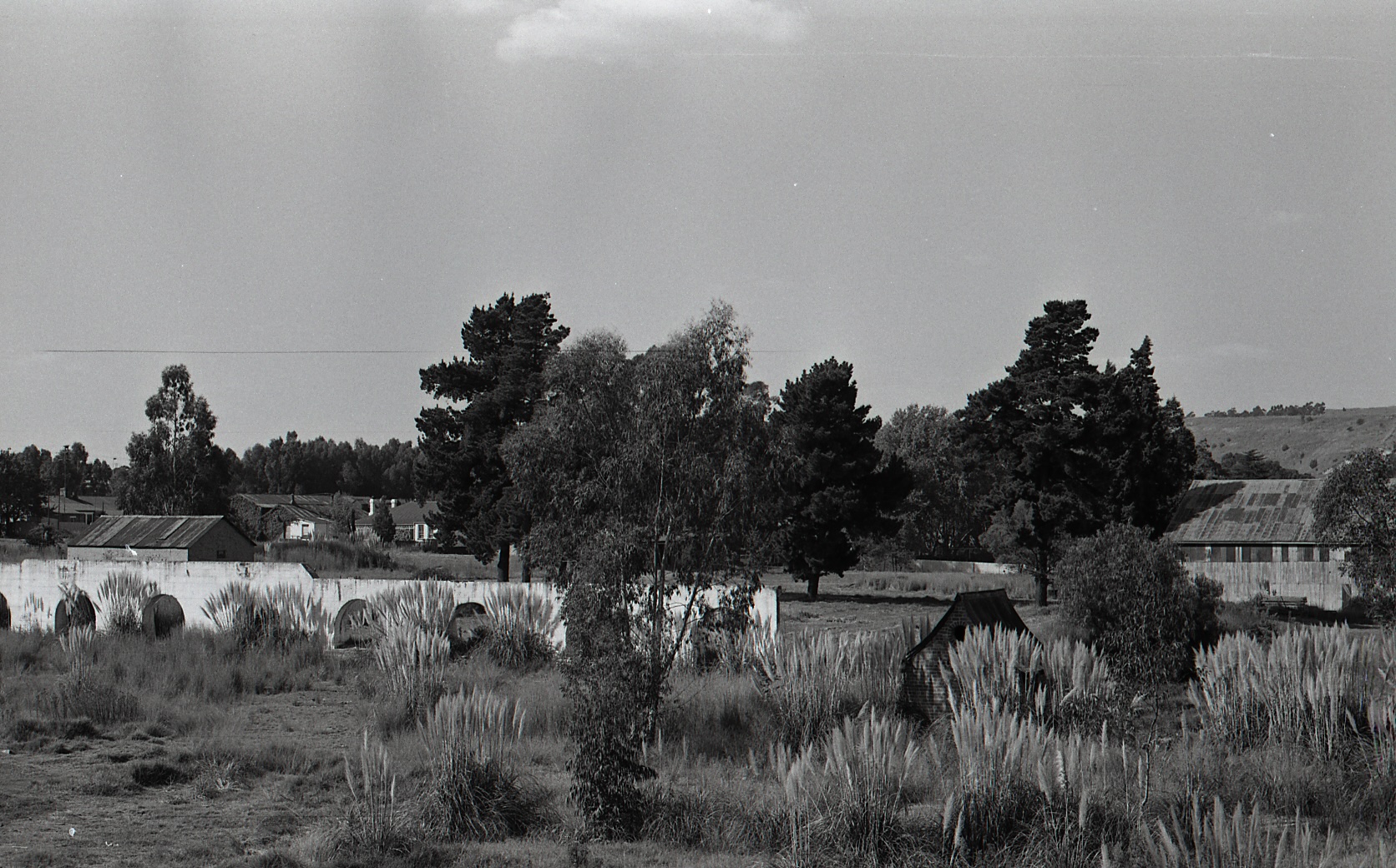 Mine landscape, Crown Mines, 1978. Photograph Lesley Lawson.
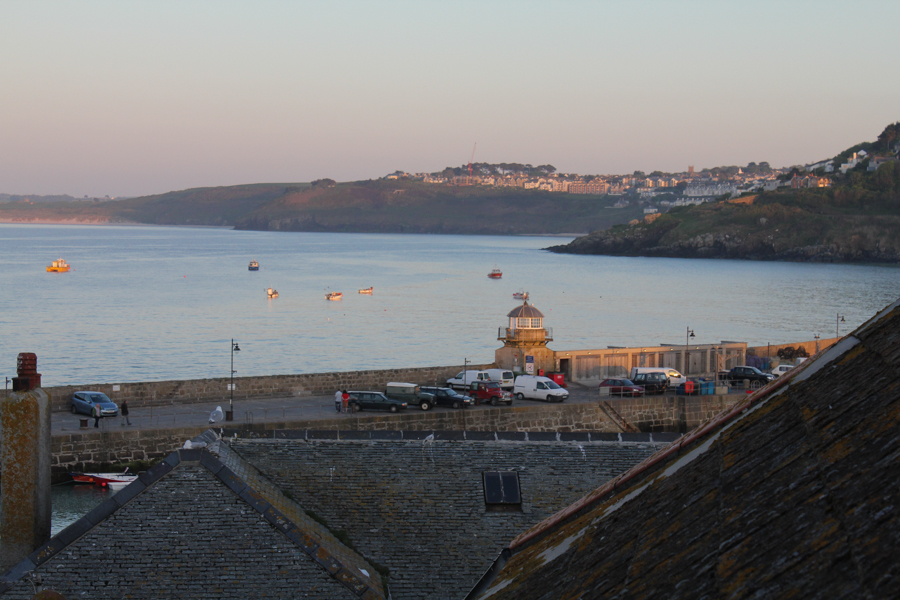 St Ives harbour from a window in Downalong, 2012. Photograph Lesley Lawson.
Cousin Jacks
Cornish mining communities around the world were close-knit and to outsiders they seemed like one big family. This earned them the nickname “Cousin Jack”. So it was in Johannesburg, where Cornish communities clustered in neighbourhoods around the mines. There was even an intersection in Johannesburg (Pritchard and Von Brandis streets) named Cousin Jack Corner, where families would meet and exchange views.
 Pritchard Street. Johannesburg, 1896. Photograph by Barnett. Wellcome Collection.
In the heyday of mining migration, Cornishmen represented around a quarter of the male population of Johannesburg. The Cornish community was prominent in the developing institutions of the city and many of the businesses, like Stuttafords and Henwoods, were Cornish-owned.
According to Cornish historian A.K. Hamilton-Jenkin, “There was plenty of fun, plenty of ‘life’, and niggers to do the work on the Rand, even though the dread scourge (phthisis) might be biding its time in the dust-filled stopes where the drills roared out unceasingly.”
Cornish identity was reinforced by social and cultural activities. There were Cornish choirs and Cornish wrestling tournaments. The Cornish Association on the Rand held dinners, festivals and fairs. In 1912 the chief justice, Lord De Villiers, opened the Cornish fair in the Johannesburg Drill Hall praising the Cornish folk for their huge contribution to the prosperity of the Rand. He encouraged single men to bring their wives and children to South Africa and make good citizens of them. “One hears a great deal about a white South Africa,” he said. “Unless people like you come and make your homes here, the country can never really be that.”
Cousin Jill
By 1909 both Grandfather Samuel and Great-grandfather James were working on Simmer and Jack mine and living nearby. The Pearce family, having arrived a year ahead of Samuel, had settled in and my grandmother, the young Mabel, was certainly enjoying her home from home. Blessed with a good singing voice she took lessons from a local music professor and by 1911 was performing as a coloratura soprano at Johannesburg concerts.
My mother spoke of Mabel’s singing prowess with some indifference. She far preferred the breathy voice of her grandmother Eliza Jane, who sang her to sleep. But still she kept a yellowed envelope with worm-eaten newspaper cuttings about these concerts. Reviews were good, describing this newcomer as a “most notable success”, “a charmingly bright soprano”, “a fair slip of a girl with perfect intonation”.
I find it hard to square this image with the dour grandmother I knew forty years later. Deflated by years of worry and anxiety, she spoke little and sang even less.
Perhaps young Samuel attended a concert and fell in love with that fair slip of a girl, ten years his junior. Or perhaps he met her over dinner in their family home. In December 1916 they were married in the Malvern Wesleyan Church.
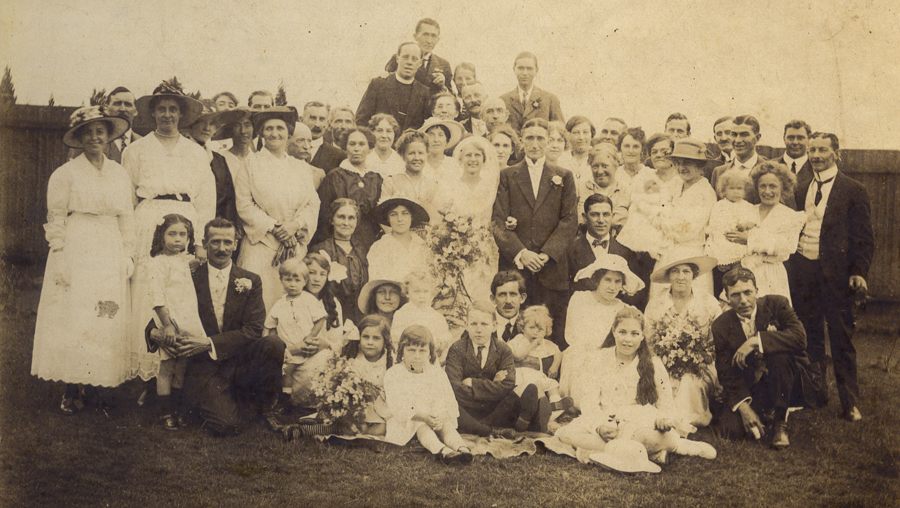 Mabel and Samuel’s wedding, Johannesburg, 16 December, 2016
Their only child, my mother Jean Pearce Roach, was born 16 months later.
References
*Luli Callnicos. Gold and Workers. Ravan Press, 1981.
*Richard Dawe. Cornish Pioneers in South Africa – Cornish Hillside Publishers, 1998. St Austell, Cornwall.
*John Nauright. Cornish Miners and the Witwatersrand Gold Mines in South Africa, c. 1890-1904. Article · January 2004. Lock Haven University
*Sharron Schwartz. The parish next door. A talk about Cornish mineworkers in South Africa. https://www.cousinjacksworld.com/talk-about-cornish-mineworkers-in-south-africa/